


How should a processing plant be built for a placer gold deposit with a thick alluvial layer? EPC turnkey solution for a complete gravity separation production line
How Should a Processing Plant Be Built for Alluvial Gold Deposits with Thick Alluvial Layers? EPC Turnkey Solution for a Complete Gravity Separation Production Line
Thick alluvial deposits in placer gold mines are both a blessing and a challenge. The blessing lies in the large reserves and long service life; the challenge stems from the high overburden volume, uneven deposit thickness, and distinct layering of clay and gravel. If the processing plant is not designed properly, it will either operate below capacity or fail to effectively wash and recover the ore.After obtaining mining rights for gold-bearing alluvial deposits with thick layers, many mine owners are most concerned about three issues: how to build the processing plant, how to configure the gravity separation production line, and exactly what is included in the EPC turnkey solution. This article explains the logic behind constructing a processing plant and the EPC solution for a complete gravity separation production line based on the characteristics of gold-bearing alluvial deposits with thick layers.
I. Ore Characteristics of Thick Alluvial Sand Gold Deposits
Thick alluvial deposits indicate that the ore body has been transported and deposited over long distances by water currents. Compared to colluvial and residual deposits, they exhibit several distinct characteristics:
First, gold is primarily present in the form of free, individual particles, eliminating the need for grinding. Recovery relies on washing, screening, and gravity separation without crushing or grinding, resulting in electricity and steel consumption that is significantly lower than that of rock gold processing plants.
Second, the ore body exhibits distinct stratification, with clay and gravel content varying with depth. Thick alluvial deposits typically consist of a layer of fine sand and clay at the top and a layer of sand and gravel at the bottom, with gold particles concentrated at the bedrock surface or within the sand and gravel layer. Mining involves a large amount of overburden removal, and the clay content and particle size distribution of the ore fed into the processing plant fluctuate depending on the mining section; therefore, the processing plant\'s workflow must allow for flexibility.
Third, gold particles are well-rounded and exhibit a wide particle size distribution. Coarse and fine gold particles coexist; coarse gold is recovered early via chutes, while fine gold is recovered using centrifuges and shaking tables—no single piece of equipment can achieve complete recovery.
Fourth, the processing capacity is high, and the service life is long. Sand gold deposits with thick alluvial layers are typically processed using fixed, large-scale production lines, which have low unit processing costs; however, the initial investment in civil engineering and equipment is higher than that for mobile units.
GoldProcessingPlant has extensive process expertise in the field of placer gold processing. While thick alluvial placer gold deposits are processed according to standard placer gold gravity separation logic, the ore washing stage, coarse gold recovery stage, and production capacity must be specifically designed to accommodate the characteristics of thick-layer deposits.
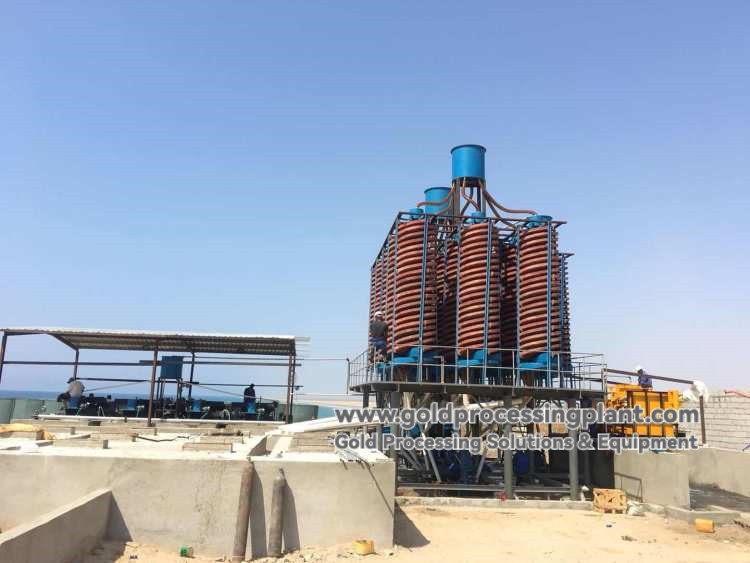
II. Process Flow of the Complete Gravity Separation Production Line
The recovery logic for thick alluvial sand gold deposits can be summarized as follows: first, thoroughly wash the ore; then, separate it into coarse and fine fractions; recover coarse gold early; and thoroughly remove fine gold.
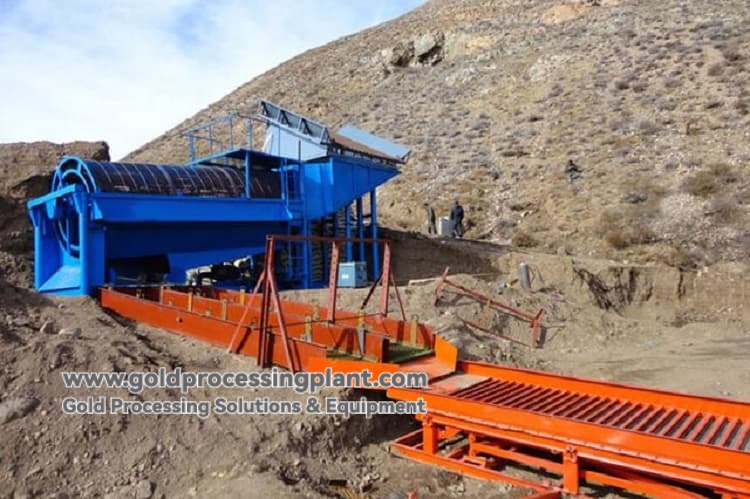
The standard process is as follows: ore washing and classification using a trommel screen or ore washer → roughing in chutes → enrichment in a centrifugal concentrator → fine selection on shaking tables → smelting of the combined gold. Over-size waste rock is discharged, while the under-size slurry enters the gravity separation system; the recirculating water system recovers most of the process water.
1. Ore Washing and Classification: The Core Step for Thick Alluvial Deposits
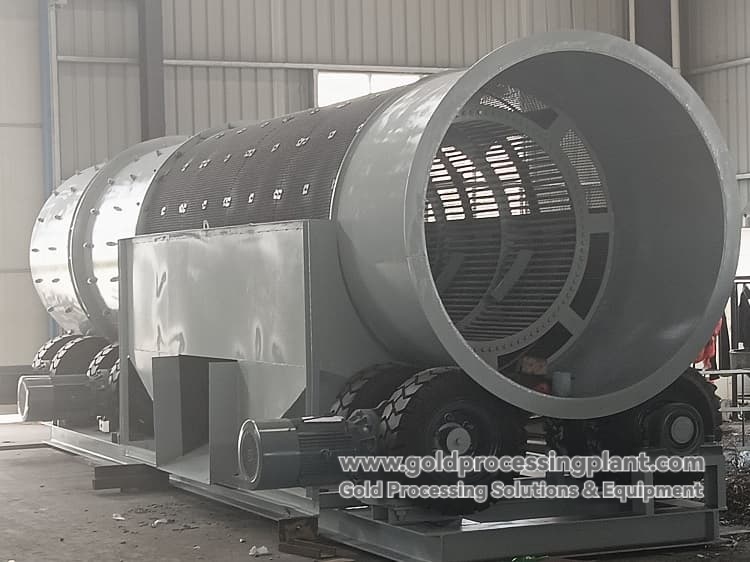
The clay content in thick alluvial deposits varies with depth, so ore washing must be thorough and allow for flexibility in adjustment. Cylindrical ore washers or trommel screens combine washing and screening functions; high-pressure water flushing, combined with the rotation of the cylinder, breaks up clay clumps.For mining sections with high clay content, a two-stage configuration is recommended: preliminary washing with a spiral washer followed by secondary washing with a trommel screen. The pressure and flow rate of the wash water can be adjusted according to the clay content to prevent downstream chute blockages and gold loss in the centrifuge caused by inadequate cleaning by a single piece of equipment.
Screen aperture size is determined based on gold particle size and the requirements of subsequent equipment; typically, the material is classified into coarse and fine fractions, which are fed into different gravity separation devices.
2. Chute Roughing: Capturing Coarse Gold Particles
The slurry from the undersize of the ore washer enters the sluice boxes. Sluice boxes feature a simple structure, high throughput, and low cost, making them suitable as roughing and concentration equipment.For gold-bearing sand deposits in thick alluvial layers, which have high processing capacities, the chute configuration must ensure sufficient length, slope, and the number of parallel units; gold-trapping mats or agitated chutes should be selected based on slurry concentration. Concentrates from the chutes are periodically cleaned out and sent to centrifugal separators or shaking tables for further enrichment.
3. Enrichment Using a Centrifugal Separator: The Key to Recovering Fine-Grained Gold
The proportion of fine-grained gold in thick alluvial deposits is significant, and sluices have limited recovery capacity for this fraction.Centrifugal separators enhance gravity separation based on the principle of centrifugation, achieving significant enrichment of ultrafine gold particles; they are the core equipment for recovering fine-grained gold from placer gold deposits. Feed particle size, centrifugal force, and backwash water pressure must be adjusted according to the properties of the ore.
4. Shaking Table Refining: Producing Qualified Concentrate
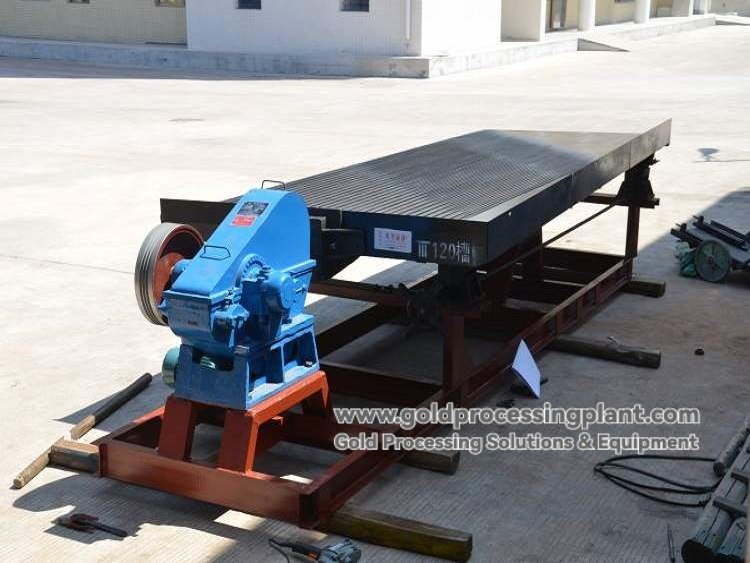
The concentrate from the centrifuge and the chute are combined and fed to the shaking table for final selection. 6-S shaking tables or multi-deck suspended shaking tables offer high separation precision, enabling further separation of heavy minerals from light gangue to produce gold concentrate suitable for direct smelting.Shaking table operating parameters (stroke, stroke rate, transverse slope, and feed concentration) directly affect concentrate grade and must be calibrated on-site during the commissioning phase.
5. Smelting: Production of Alloyed Gold
After drying and blending, the concentrate is fed into a gold smelting furnace to produce bulk gold ingots. As the concentrate may contain associated heavy minerals such as magnetite and ilmenite, magnetic separation to remove iron or acid leaching pretreatment may be performed prior to smelting, depending on the circumstances.
Since the entire process does not involve crushing or grinding, equipment investment and operating costs are one order of magnitude lower than those of a rock gold ore processing plant.
III. How to Build a Concentrator: Fixed-Type Plants Prevail; Capacity Matching Is Key
Gold deposits in thick alluvial layers feature large reserves and long service lives, so they are typically configured as stationary processing lines. The core of plant construction is not “the bigger the equipment, the better,” but rather capacity matching and process flexibility.
Determining Processing Capacity: Work backward from the ore body reserves, mining capacity, and service life to determine the daily processing capacity. Processing scales ranging from 30 metric tons per day to 5,000 metric tons per day can be accommodated; projects involving thick alluvial deposits typically fall within the medium-to-large range.
Site Layout: The ore washing, chutes, centrifuges, and shaking tables are arranged according to the process flow, supported by a recirculating water system and tailings discharge facilities. Site grading and civil engineering foundations must be constructed in accordance with the civil engineering conditions drawings provided by our company.
Process Adjustment Capability: Since the clay content and particle size of thick alluvial deposits vary with the mining section, allowance must be made for adjustments to ore washing water pressure, chute gradients, centrifuge backwash water, and shaking table parameters. A margin for operational flexibility is incorporated into the design.
Recirculating Water System: Placer gold processing requires a large volume of water; the recirculating water system recovers most of the process water, reducing fresh water consumption and environmental impact.
Tailings Disposal: Oversize waste rock and gravity separation tailings shall be centrally stockpiled or backfilled in accordance with environmental protection requirements; dry tailings disposal facilities shall be configured in accordance with local environmental protection requirements.
IV. What Exactly Is Included in an EPC Turnkey Solution?
Most disputes and delays in mineral processing plant construction stem from a failure to clearly define “who is responsible for what” before signing the contract. The core principle of GoldProcessingPlant\'s EPC services is: we take full responsibility for what falls under our purview and provide advance briefings on matters requiring client cooperation.
What GoldProcessingPlant Is Responsible For
- Process Design and Technical Solutions: Analysis of ore sample characteristics, determination of processing flows, equipment selection, and preparation of proposal documents with preliminary quotations.
- Engineering Design and Drawings: Core design drawings such as site layout plans, equipment layout diagrams, and civil engineering condition drawings, along with a complete technical briefing.
- Manufacturing of Core Equipment and Supply of Supporting Components: Manufacturing core equipment—such as trommel screens, ore washers, chutes, centrifugal concentrators, shaking tables, and sand pumps—in accordance with drawings; coordinating the supply of auxiliary materials, including pumps, piping, and electrical controls, to ensure seamless integration between hardware and process.
- On-Site Installation Technical Guidance: Dispatch engineers to the site to supervise equipment positioning, pipeline connections, and electrical and instrumentation installation, ensuring that construction crews follow the drawings precisely.
- Integrated Commissioning and Personnel Training: Lead the commissioning of individual units and full-process integrated trial runs with water and feed material; optimize parameters such as feed concentration, rinse water pressure, centrifuge backwash water, and shaking table inclination until standards are met and full production capacity is achieved; provide theoretical and hands-on training to the client\'s team.
- After-Sales Service and Spare Parts Supply: We assume responsibility for equipment quality during the warranty period and provide long-term spare parts supply and process optimization recommendations.
Client Responsibilities
- Civil Engineering Construction: The client shall independently organize civil engineering construction in accordance with the civil engineering specifications provided by us (equipment foundations, loads, reserved openings, water and electricity connections, etc.). If complete architectural construction drawings involving plant structures, foundation reinforcement, etc., are required, these must be issued by a qualified local design institute.
- Organization of Local Installation Workers: Specific installation tasks—such as equipment positioning, pipe welding, and cable laying—must be carried out by workers recruited locally by the customer. Our engineers will provide on-site guidance on installation procedures, while the customer is responsible for organizing the workforce to perform the work.
- On-site Infrastructure: The client is responsible for ensuring the site is “connected to water, electricity, and roads, and leveled” (three utilities and site leveling), as well as for preparing the water, electricity, and materials required for equipment hoisting and commissioning.
- Local Compliance Procedures: The client is responsible for obtaining local approvals, including environmental protection, safety, and construction permits, at the project site.
Why This Division of Labor Is More Cost-Effective: If we were to dispatch a large number of Chinese workers overseas or to remote locations for construction, the costs—including airfare, visas, room and board, plus high daily wages—would be astronomical. By having the client recruit local installation workers on-site while we provide technical engineers for guidance, labor costs can be reduced by at least half.At the same time, communication with local workers is easier, and they can adapt more flexibly to the progress of on-site civil engineering work, avoiding delays caused by waiting for visas or flights. We still assume full responsibility for technical risks—while the client sources the workers, our engineers make the final on-site decisions regarding installation methods and standards.
If the client is unable to find a construction team locally, or wishes us to take full responsibility for both civil engineering and installation workers, we can also specify the scope of work and calculate costs separately in the contract based on the actual conditions at the project site.
V. EPC Project Timeline and Schedule
For a typical alluvial gold mine EPC project, the overall timeline from process design to production start-up is usually 8 to 15 months. Key milestones:
Process Design, Equipment Selection, and Quotation: Approximately 7–15 days. The sooner the ore samples are provided, the better; since thick alluvial deposits have a wide particle size distribution, representative samples are required for screening and gravity separation tests.
Engineering Drawing Design: Approximately 20–30 days; this phase may overlap with equipment manufacturing.
Equipment Manufacturing: 60–120 days. Standard gold-in-sand gravity separation equipment can be produced relatively quickly; lead times are extended accordingly for non-standard customizations (such as special wear-resistant materials or diesel generator sets for power supply in Africa).
Logistics and Transportation: 30–60 days. Overseas projects are highly dependent on shipping routes and schedules; it is recommended to allow ample buffer time.
Installation and Commissioning: 60–150 days.The gold ore beneficiation process is relatively simple (ore washing followed by gravity separation, with no grinding or cyanidation), but calibrating the washing and gravity separation parameters takes time. Parameters such as feed concentration, rinse water pressure, centrifuge backwash water, and shaking table slope must all be determined based on data from trial runs with actual feed material.
Customs Clearance and Unforeseeable Delays: Allow approximately 30 days; this is essential for cross-border projects.
Reasonably overlapping the various phases can shorten the total project duration. Many project delays are not caused by equipment manufacturing issues, but rather by indecision in the early stages or a failure to properly overlap the various phases.
VI. Four Common Pitfalls in Thick Alluvial Gold Deposits
- Pit 1: Inadequate ore washing, resulting in complete failure downstream. The clay content in thick alluvial deposits varies with depth. If corners are cut during the ore washing process, clay clumps enter the sluice boxes and centrifuges, causing gold to be carried away by the mud into the tailings. The selection of ore washing equipment and the pressure of the wash water must be designed based on the clay content, with room for adjustment.
- Pit 2: Relying solely on sluices without centrifuges results in incomplete recovery of fine-grain gold. Sluices are effective for coarse-grain gold but have limited recovery capacity for fine-grain gold. Since fine-grain gold constitutes a significant proportion of thick alluvial deposits, the absence of centrifugal separators and shaking table scavenging leads to noticeably high tailings grades.
- Pitfall 3: Designing production capacity based on peak demand leads to the processing line being either “underutilized” or “overloaded” as the mining section changes. Thick alluvial deposits involve significant overburden removal, and the volume of ore fed into the plant fluctuates with mining progress. The production line must be designed for average throughput with room for adjustment; a one-size-fits-all approach based on peak demand is not feasible.
- Pitfall 4: Commissioning equipment without verifying ore samples. The particle size and clay content of gold in thick alluvial deposits can vary significantly at different depths.Without screening and gravity separation test data from representative ore samples, equipment selection becomes nothing more than a guess based on experience. GoldProcessingPlant\'s approach is to first examine the ore, then conduct tests, and finally select equipment—the ore sample feasibility test report directly includes the equipment selection list and a preliminary budget.
VII. Why Choose GoldProcessingPlant for EPC Projects in Thick Alluvial Sand Gold Deposits
Process-First Approach, No One-Size-Fits-All Templates
Thick alluvial deposits differ from colluvial, residual, and riverbed deposits in terms of clay content and grain size distribution; therefore, process parameters should not be the same. GoldProcessingPlant has over 20 years of experience in gold ore beneficiation process design and equipment manufacturing, with proven solutions for the entire process—from placer gold washing and gravity separation to refining.
In-House Equipment Manufacturing: Process and Hardware Seamlessly Integrated
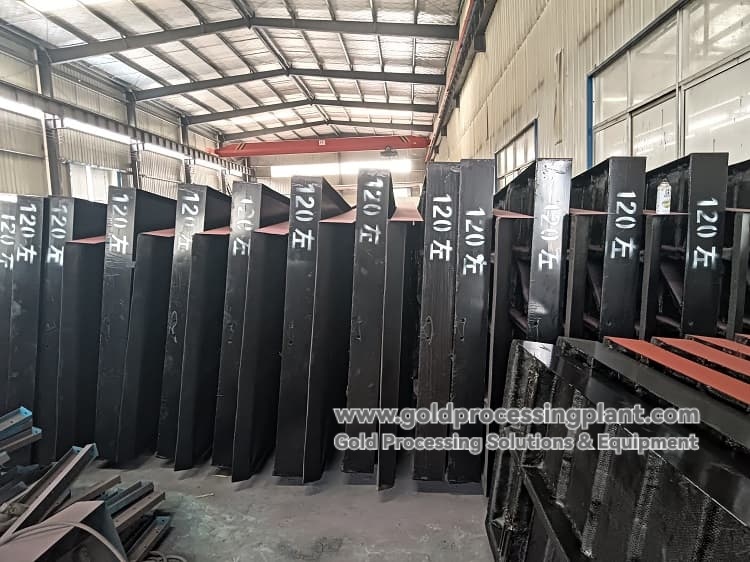
We independently manufacture the full range of equipment for the placer gold gravity separation process—including trommel screens, ore washers, chutes, centrifugal separators, shaking tables, and sand pumps. Process engineers and mechanical engineers collaborate as a single team, ensuring equipment is manufactured according to process drawings to avoid discrepancies such as “design drawings not matching equipment dimensions.”With two major manufacturing bases covering approximately 50,000 square meters and an annual production capacity exceeding 500 units, our products are exported to more than 50 countries and regions. We strictly adhere to the ISO 9001 quality management system, and our products are CE certified.
Unbroken EPC Responsibility Chain
We provide comprehensive coordination of process design, equipment manufacturing, installation guidance, integrated commissioning, and personnel training, and take full responsibility for the final production targets. We do not shift blame to design institutes, equipment manufacturers, or construction teams when issues arise.
Global Project Experience
Projects span major gold-producing regions including Ghana, Mali, and Tanzania in Africa; Peru and Colombia in South America; Russia and Kazakhstan in Central Asia; and Southeast Asia, with processing capacities ranging from 30 to 5,000 metric tons per day. We are well-versed in international logistics, customs clearance procedures, and construction standards across different countries.In Africa, where power supply is unstable, we provide diesel generator sets; to address transportation difficulties during the rainy season, we stock up in advance; and when local workers have limited technical skills, we provide hands-on training.
Flexible Phased Implementation, No Mandatory Bundling
Clients may choose to conduct only mineral processing tests, purchase only process design and equipment selection plans, procure only equipment, or hire engineers for on-site commissioning; alternatively, they may opt for full-process EPC. Upfront payments for mineral processing tests and design fees can be fully offset against equipment costs when subsequent equipment or EPC contracts are signed.
Ongoing Technical Support
Commissioning and reaching full production capacity are just the beginning of our partnership. We assume responsibility for equipment quality during the warranty period and, after the warranty expires, continue to supply spare parts, provide technical consultation, and offer process optimization recommendations on an ongoing basis. As the grade and silt content of thick alluvial deposits vary across different mining sections, recovery parameters must be adjusted accordingly—and we\'ll be there every step of the way.
Alluvial deposits in placer gold mines are thick; the challenge in constructing a processing plant lies not in individual pieces of equipment, but in whether the “ore—process—equipment” triad is properly aligned, and whether the scope of the EPC delivery is clearly defined.If the clay content is unclear, the ore washing equipment will be mismatched; if the proportion of fine-grained gold is unknown, the gravity separation process will be incomplete; if capacity is designed for peak production only, problems will arise as soon as the mining section changes; if the scope of delivery is not clearly defined, disputes will lead to work stoppages later on—every decision error results in lost gold in the tailings and project delays.
GoldProcessingPlant\'s approach is as follows: first, assess the ore type and deposit conditions to determine the processing route; then, select equipment based on the process; and finally, dispatch engineers to the site to fine-tune operations until gold is recovered.For placer gold deposits, there is no grinding or cyanidation; gold is recovered entirely through washing and gravity separation. The EPC model integrates the responsibilities for design, equipment, and commissioning into a single, seamless process. When this approach is followed correctly, the return on investment for deposits with thick alluvial layers and large reserves is achieved much faster than for bedrock gold deposits.
The core of constructing a gold processing plant for alluvial sand deposits and implementing an EPC turnkey solution lies in “first assessing the ore, determining the process, selecting equipment, and clearly defining the scope of work”:With a process flow centered on ore washing and classification, chute roughing, centrifugal enrichment, shaking table fine selection, and smelting of consolidated gold, the scale of the fixed production line is determined based on reserves and mining capacity, while allowing for flexibility in process adjustments;EPC responsibilities are clearly defined—the manufacturer is responsible for process design, equipment manufacturing, installation guidance, integrated commissioning, and training, while the client is responsible for civil engineering, local labor, site preparation (water, electricity, and road access), and regulatory compliance. Only by ensuring a seamless chain of responsibility can tailings losses and project delays be avoided.