


How to Configure a Complete Set of Equipment for a Placer Gold Processing Line? Design and Pricing for a 300-Metric-Ton-Per-Day Gravity Concentration Plant
How to Configure a Complete Set of Equipment for a Placer Gold Processing Line? Design and Pricing for a 300-Metric-Ton-Per-Day Gravity Concentration Plant
Alluvial gold deposits and bedrock gold deposits follow two completely different processing logics. In alluvial gold deposits, gold exists in a free, individual form and does not require grinding. The core process can be summarized in four words: washing, screening, gravity separation, and beneficiation.A 300-metric-ton-per-day placer gold processing plant is considered medium-scale among stationary solutions. With proper configuration, a single line can consistently produce gold that meets quality standards; with improper configuration, fine-grained gold will be washed away with the water, rendering even high processing capacity futile.
This article uses 300 metric tons per day as a benchmark to clearly explain the process flow, complete equipment configuration, price references, and key construction points for a placer gold processing line.
I. First, let\'s examine the logic behind placer gold processing: Why grinding is unnecessary
In placer gold deposits (alluvial, riverbed, residual slope, and lakebank deposits), gold exists in a free, individual state within loose sediments such as sand, gravel, and clay. The relationship between gold particles and gangue is physically loose, rather than an embedded or encapsulated one. Therefore:
Crushing and grinding are not required
The gold particles are already free; grinding would only break down coarse gold particles and increase silt content;
The key is washing and gravity separation
First, the clay is washed away to separate the gold from the sand and gravel; then, the gold is recovered using gravity separation equipment based on density differences;
Coarse gold is recovered early, while fine gold is swept up
Chutes and centrifuges handle coarse gold, while shaking tables handle the fine gold concentration.
Two configurations for placer gold processing plants: Mobile solutions are suitable for dispersed ore deposits and short-term mining operations—simply set up and go; stationary solutions are suitable for concentrated ore sources and large-scale operations such as those at the 300-metric-ton level. For a capacity of 300 metric tons per day, a stationary setup is recommended, as it offers better control over equipment specifications and recovery rates.
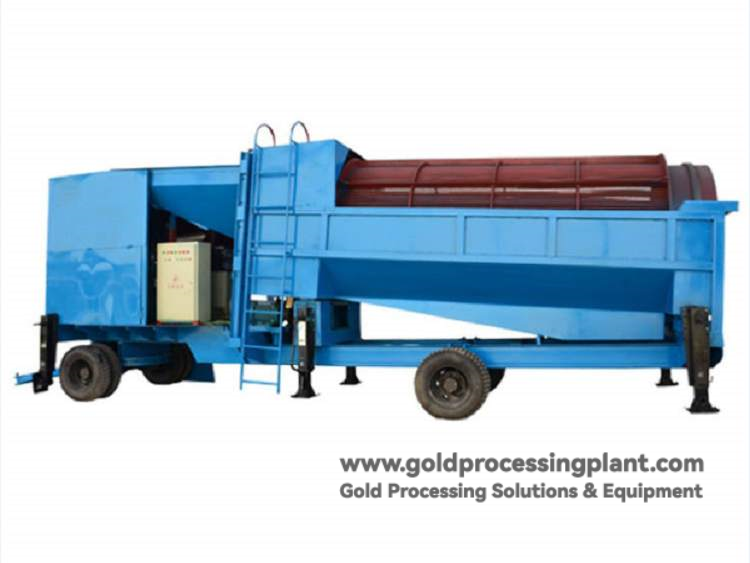
II. Process Flow for a 300-metric-ton-per-day Placer Gold Processing Line
The standard gravity separation process is as follows:
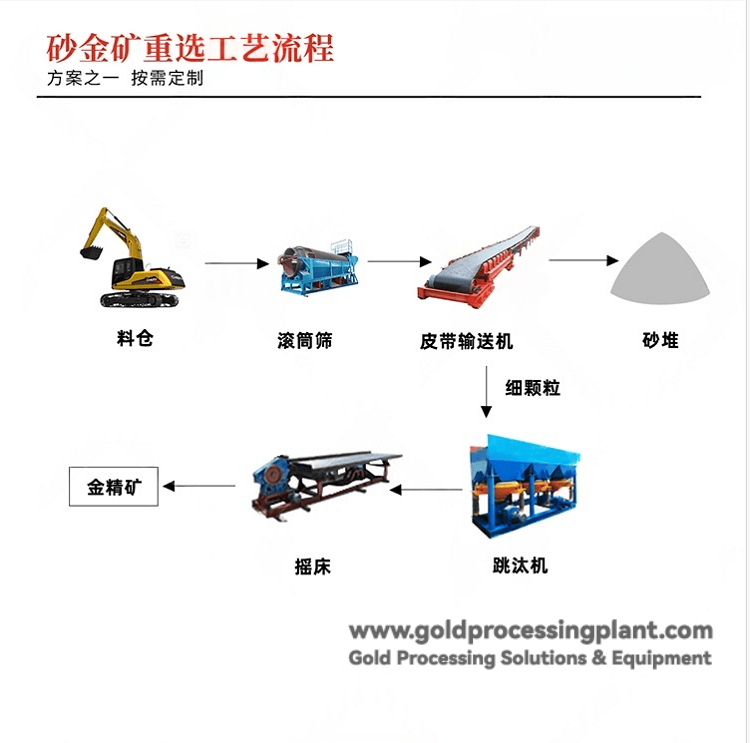
Raw ore feeding → Washing and classification using a trommel screen or ore washer → Under-screen slurry enters the chute for roughing → Enrichment using a centrifugal concentrator → Fine selection using a shaking table → Smelting of combined gold
Over-size waste rock is discharged, while the under-size slurry enters the gravity separation system; the recirculating water system recovers most of the process water, reducing fresh water consumption.
Functions and Key Configuration Points of Each Stage:
1. Ore Washing and Classification (Trommel Screen/Cylindrical Washer)
Placer gold ores often contain clay; if the clay is not washed away, the gold becomes trapped in the mud and cannot be recovered by gravity separation equipment. The trommel screen combines washing and screening functions, offers high throughput, and is resistant to clogging, making it the first core piece of equipment in a placer gold processing line.When clay content is high, enhanced ore washing is required (e.g., high-pressure water flushing, extended washing time); if necessary, a spiral ore washer can be used for pretreatment.
2. Roughing (Chutes)
The undersize slurry enters the chute for roughing and concentration. Chutes feature a simple structure and high throughput, making them suitable for the initial recovery of coarse-grained gold and intergrown particles. Agitated chutes or gold-adhering chutes are selected based on ore characteristics and operational practices. The concentrate from the chute is periodically removed and sent to the next stage for fine selection.
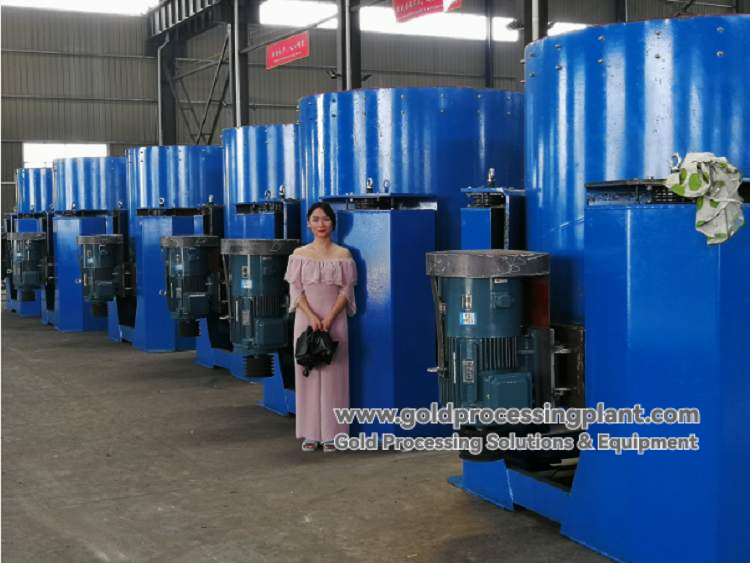
3. Enrichment (Centrifugal Separator)
Centrifugal separators enhance gravity separation based on the principle of centrifugal force, achieving significant recovery of fine-grained gold; they are key equipment for recovering fine-grained gold in placer gold processing lines. Coarse concentrate from the chutes or undersize slurry is enriched by the centrifuge, substantially improving the concentrate grade.
4. Fine Selection (Shaking Tables)
The 6-S shaking table offers high separation precision and is used for fine-grain concentration, further refining the centrifuge concentrate into high-grade gold concentrate. Although the shaking table has a relatively low throughput, this is well-suited to the naturally low throughput of the concentration stage.
5. Smelting (Blended Gold)
The shaking table concentrate is processed using a mercury-free alternative process (where gravity concentration concentrate is either directly smelted or sold as concentrate) to produce alloy gold. The system includes a smelting furnace, crucibles, and flux. Modern placer gold processing lines generally follow a “gravity concentration replacing mercury” mercury-free approach to meet environmental requirements.
6. Recirculating Water System
Placer gold processing plants consume large amounts of water; the recirculating water system recovers most of the process water and is equipped with settling tanks and recirculation pumps. In regions with strict environmental regulations, tailwater must be treated to meet compliance standards.
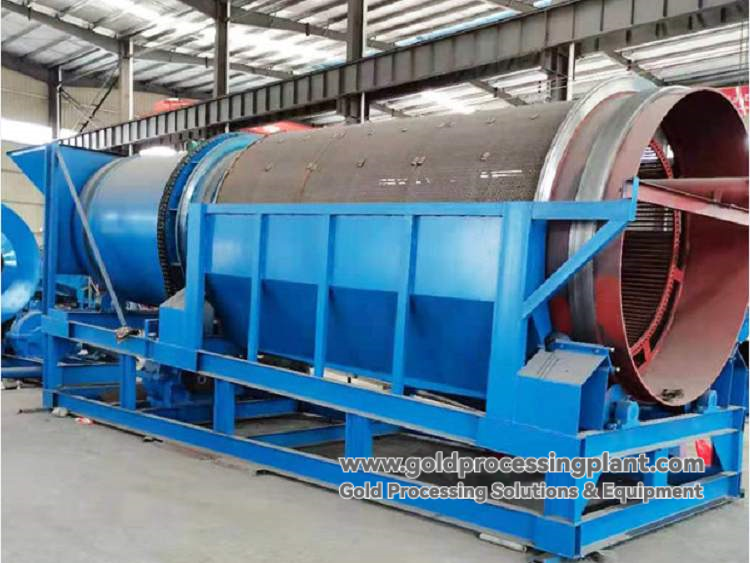
III. Complete Equipment Configuration List for a 300-metric-ton-per-day Plant
Based on the above process flow, the main equipment configuration for a 300 metric tons per day stationary placer gold processing plant is as follows:
| Process Step | Equipment | Configuration Highlights |
|---|---|---|
| Feeding | Vibrating Feeder/Hopper | Ensure uniform and stable feeding to avoid shock loads |
| Ore Washing and Screening | Trommel Screen/Cylindrical Ore Washer | Processing capacity of 300 metric tons per day; enhanced flushing for high clay content |
| Rough Selection | Chutes (Agitated/Gold-Bearing) | Selected based on ore characteristics; concentrate is cleared periodically |
| Enrichment | Centrifugal separator | Key equipment for recovering fine-grain gold; number of units determined by processing capacity |
| Enrichment | 6-S Shaking Table | High sorting accuracy; processing capacity is matched to concentrate yield |
| Smelting | Gold Smelting Furnace, Crucibles, Molds | Mercury-free process; direct smelting of concentrate |
| Conveyance | Belt conveyors, sand pumps, slurry pumps | Connecting various process stages; slurry conveyance |
| Water Supply | Recirculation tank, return pump, settling tank | Recycle process water to reduce fresh water consumption |
| Electrical | Power distribution panels, soft starters | Diesel generator sets provided for areas with unstable power supply |
Three Key Considerations for Equipment Configuration:
First, the ore washing section must not be overlooked or under-engineered. The most common mistake in placer gold processing lines is insufficient ore washing, resulting in clay-coated gold entering the gravity separation stage, and chutes and centrifuges running completely dry. The specifications of the trommel screen and the flushing water pressure must be adequately configured based on the clay content.
Second, coarse and fine gold must be recovered in separate stages. Chutes retain coarse particles, centrifuges capture fine particles, and shaking tables perform precise separation—each stage fulfills its specific function. If only chutes are used without centrifuges and shaking tables, the recovery rate of fine gold will remain low; if only centrifuges are used without chutes, the processing capacity for coarse gold will be insufficient.
Third, the equipment must be seamlessly integrated as a complete system. The discharge particle size of the trommel screen, the processing capacity of the sluices, the number of centrifuges, and the processing capacity of the shaking tables must be matched step by step. If equipment from different manufacturers is pieced together, mismatches in interfaces and processing capacity will cause material blockages or idle operation in intermediate stages, thereby reducing the efficiency of the entire line.
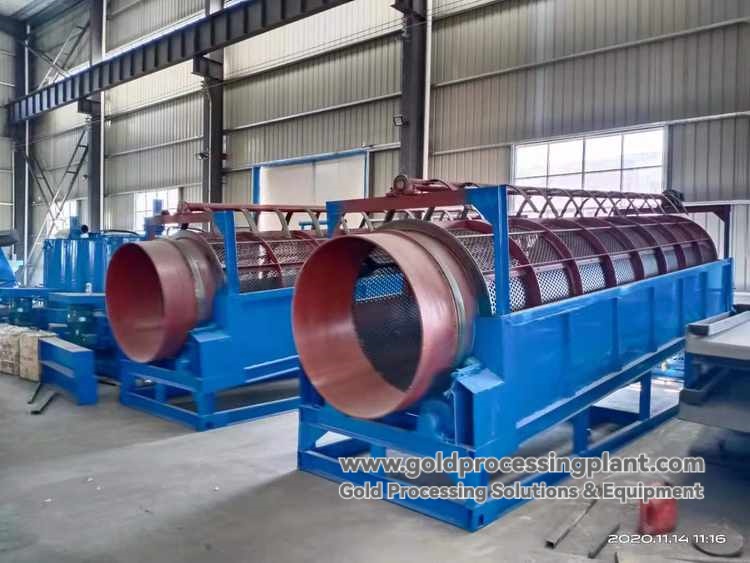
IV. Price Reference: Investment for a 300-metric-ton-per-day placer gold processing plant
The equipment configuration of a placer gold gravity separation line is entirely different from that of a rock gold CIP/CIL line; it does not include leaching, adsorption, or desorption/electrolysis systems, so the investment in main equipment is relatively low. Reference figures (in ten thousand U.S. dollars, excluding civil engineering, installation, logistics, and auxiliary materials):
- Main equipment for a placer gold gravity separation line (trommel screens, chutes, centrifuges, shaking tables, sand pumps, conveyors, smelting) based on a 300 metric tons per day capacity; specific prices must be calculated individually based on mud content, gold particle size, and automation configuration;
- As a general comparison, a complete set of main equipment for a 300-metric-ton-per-day CIP/CIL line costs approximately $600,000–$900,000. The main equipment for a placer gold gravity separation line is typically less expensive than that of a cyanide leaching line of the same capacity, but specific pricing is subject to the quotation based on the proposed design.
Three factors affecting price fluctuations:
- Silt content and processing difficulty: Where clay content is high or enhanced ore washing is required, larger-scale washing equipment is needed, resulting in higher prices;
- Level of automation: There is a significant difference in configuration between manual chute cleaning versus automatic chute cleaning, and between manual shaking table monitoring versus automatic control;
- Site conditions: Unstable power supply requiring diesel generator sets, or remote locations necessitating reinforced equipment structures to accommodate transportation, will both affect the total price.
Quotation Principles: The lower limit of the price range corresponds to standard configurations, typical ore characteristics, and standard operating conditions; the upper limit corresponds to non-standard customization, complex operating conditions, and more comprehensive configurations. Specific quotations must be determined based on ore samples and on-site conditions.
V. Key Construction Points and Project Timeline
Site and Water Sources:
Placer gold processing plants must be located near ore sources and water sources, with leveled sites and unobstructed drainage; recirculation tanks and settling ponds must be designed in accordance with environmental protection requirements, and tailings discharge must meet regulatory standards.
Power Configuration:
A stationary 300-metric-ton processing line requires a significant amount of electrical equipment. In areas with unstable power supply, diesel generator sets are standard equipment to serve as either the primary or backup power source. Soft-start configurations are used to reduce inrush current, and voltage stabilizers are installed for critical control systems.
Project Timeline:
The processing flow for placer gold gravity separation lines is simpler than that for rock gold cyanidation lines, and equipment manufacturing lead times are relatively short. The typical sequence is: design, equipment selection, and quotation → equipment manufacturing → logistics → installation and commissioning.By reasonably interweaving these phases, the overall project duration is typically shorter than the 8–15 months typical for rock gold mines, though this depends on the degree of equipment customization and on-site conditions. Providing ore samples and site data as early as possible to initiate the conceptual design is the first step toward shortening the project timeline.
Phased Construction:
If the budget is limited, construction can begin with the core sections—mineral washing, chutes, and centrifuges—to ensure concentrate production; the shaking table enrichment, smelting, and recirculating water systems can be added later. The initial design should include provisions for future integration to ensure process continuity.
VI. Troubleshooting Common Issues in Placer Gold Processing Plants
Severe Loss of Fine-Grained Gold in Tailings
Check the centrifuge configuration and operating parameters, verify that shaking table enrichment is properly implemented, and ensure that the chutes are collecting only coarse particles;
Concentrate Grade Not Improving
Check whether the processing capacity of the shaking table enrichment stage is too high and whether the operating parameters are appropriate;
Incomplete ore washing or chute blockages
High clay content, but insufficient washing water pressure and drum screen specifications;
Processing capacity falls short of design specifications
Mismatched equipment capacities across stages, with intermediate stages becoming bottlenecks.
Targeted modifications are more cost-effective than replacing the entire set of equipment; begin by conducting a process review to identify bottlenecks.
VII. Equipment Selection for Placer Gold Processing Plants: Ore Washing and Stage-by-Stage Recovery Are Key
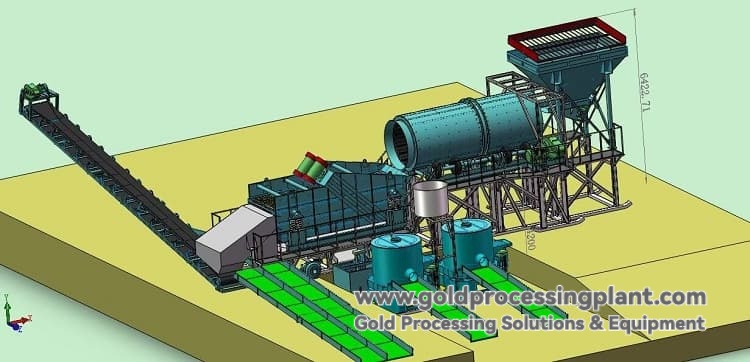
For a 300-metric-ton-per-day placer gold processing plant, the core logic behind the equipment configuration is: thorough ore washing, staged recovery of coarse and fine particles, and seamless integration of equipment across all stages.Since sand gold ore is not ground, cost savings come from a shorter process; however, if ore washing and gravity separation are not properly configured, losses also result from this shortened process—without a subsequent cyanidation backup, the lost gold is truly lost.
The correct sequence is: Take representative ore samples for mud content and gold particle size analysis → Determine the ore washing and gravity separation processes → Configure a complete set of equipment based on processing capacity → Conduct on-site commissioning to optimize water flow rates and gravity separation parameters.
If you are planning a placer gold processing line, or if your existing placer gold plant is experiencing poor recovery of fine-grain gold, please contact GoldProcessingPlant for ore sample analysis and process design.