


How to Choose a Mineral Processing Plan and a Complete Set of Equipment for Colloidal Gold Production?
How to Choose a Colloidal Gold Production and Mineral Processing Plan and a Complete Set of Equipment?
The term “colloidal gold” actually has two completely different contexts in the gold mining industry: one is the “gel-like gold” or “colloidal gold” referred to by veteran technicians at mineral processing sites—this refers to gold that is extremely fine in particle size and exists in the ore in a gel-like or finely dispersed state;the other refers to colloidal gold tracers used in the biomedical field. This article focuses on the former: gold in ore that exists in a colloidal state, dispersed as fine particles, and is difficult to recover completely using conventional gravity separation or cyanidation. Determining the appropriate processing plan and selecting the right set of equipment for this type of ore is a genuine headache for many mine owners.
I. First, let\'s clarify: Which type of ore do you mean by “colloidal gold”?
In gold ore beneficiation practice, the term “colloidal gold” typically refers to the following scenarios:
1. Fine-grained disseminated gold deposits (Karin-type)
Gold is encapsulated within sulfides such as pyrite and arsenopyrite in the form of invisible or submicroscopic particles, making it difficult to liberate as individual particles no matter how finely the ore is ground. This type of ore is a classic example of hard-to-process gold ore; direct whole-slurry cyanidation recovery rates are often only 20–30% to 50%.
2. Colloidal and earthy oxidized gold ores
Gold exists in a colloidal state, adsorbed onto the surfaces of limonite, clay minerals, or manganese oxides. It is commonly found in iron-capped and lateritic weathered deposits. The gold particles are extremely fine, resulting in low recovery rates via gravity separation; furthermore, high clay content adversely affects the rheology of the pulp and its leaching permeability.
3. “Gold-snatching” ores containing carbonaceous matter
Carbonaceous materials in the ore (such as organic carbon and graphite) adsorb dissolved gold cyanide complexes, causing a “gold-sequestration” effect. This prevents the gold concentration in the leachate from rising, resulting in a very low apparent leaching recovery rate.
4. Fine-Grained Gold in Alluvial Gold Deposits
In placer gold deposits, coarse gold particles can be recovered using sluices and centrifuges, but micron-sized fine gold particles are easily carried away by water flow and require recovery via shaking tables or centrifuges.
The common characteristics of these four types of ores are: fine gold particles, complex occurrence patterns, and the inability to achieve complete recovery using a single process. The core of process design is not “which piece of equipment to buy,” but rather to first thoroughly understand the occurrence patterns of the gold before determining the process route.
II. How to Determine a Mineral Processing Plan for Colloidal Gold Ores
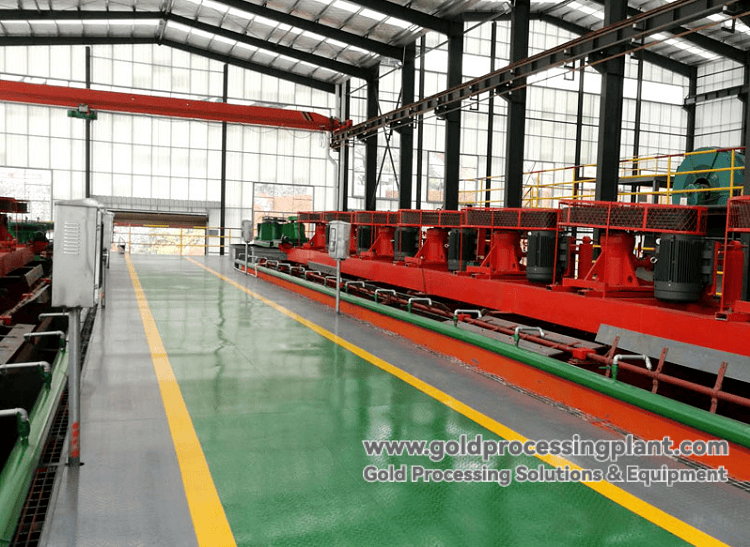
Option 1: Flotation Enrichment + Pretreatment + Cyanidation (Suitable for micro-fine-grained disseminated or arsenic- and carbon-bearing ores)
This is the mainstream route for Carlin-type ores and difficult-to-process arsenic- and carbon-bearing ores.The logic is as follows: First, use flotation to concentrate gold-bearing sulfides into a concentrate, significantly reducing the feed volume for subsequent pretreatment; then, perform pretreatment on the concentrate (using proprietary reagents, roasting, pressurized oxidation, bio-oxidation, etc.) to release the bound gold; finally, recover the gold through cyanidation.
Key points:
- The grinding fineness must ensure the individual liberation of gold-bearing sulfides, but there is no need to pursue “the finer, the better”; over-grinding increases sludge formation and reagent consumption;
- The flotation reagent regime determines the concentrate grade and sulfur recovery rate; for arsenic-bearing ores, realgar must be suppressed or the arsenic-gold concentrate must be floated separately, while for carbon-bearing ores, the gold-snatching effect of carbonaceous matter must be suppressed;
- The choice of pretreatment method depends on the arsenic/carbon content and their occurrence conditions, and directly determines economic viability.
Option 2: Gravity Separation + Cyanidation Combination (Suitable for iron-capped and colloidal oxidized ores)
Gravity separation recovers coarse-grained free gold early in the grinding circuit to prevent loss due to overgrinding; gravity separation tailings are fed into the cyanide leaching process to recover fine-grained gold. The porous structure of limonite facilitates leachate penetration, but when clay content is high, the slurry rheology must be improved using dispersants or granulation.
Option 3: Whole-ore Cyanidation (CIL/CIP) (Suitable for ores where gold is predominantly in a free state, with simple gangue and no interfering elements)
If laboratory analysis confirms that gold is predominantly in a free state and the ore contains no interfering elements such as arsenic, carbon, or antimony, direct whole-ore cyanidation is the most straightforward approach. CIL (Cyanide In-Leach) combines leaching and absorption in a single process with a compact flow scheme, making it suitable for small- to large-scale processing plants; CIP (Cyanide In-Leach and Cyanide In-Press) involves leaching followed by adsorption, allowing for more precise segmented control, and is commonly used in large-scale processing plants.
Option 4: Full-Process Ore Washing and Gravity Separation (Suitable for placer gold deposits and fine-grained placer gold)
Trommel screen/ore washer for ore washing and classification → chute roughing → centrifugal concentrator for enrichment → shaking table for fine selection. When clay content is high, enhanced ore washing is required; coarse-grained gold is recovered using chutes and centrifuges, while fine-grained gold is recovered via shaking tables or centrifugal scavenging.Mobile solutions are suitable for dispersed ore deposits, while stationary solutions are suitable for concentrated ore sources.
The golden rule for selecting a solution: Without laboratory analysis of representative ore samples and beneficiation tests, any equipment selection is like “a blind man feeling an elephant.” This is especially true for colloidal gold ores—even the slightest difference in the form of gold can lead to a process route that is worlds apart.
III. How to Configure the Complete Equipment Set: Matching Equipment to the Process Flow
1. Crushing and Grinding Stage (The Starting Point for All Rock-Type Gold Deposits)
- Jaw Crusher: Primary crushing; handles large chunks of raw ore; simple structure and durable;
- Cone Crusher: Medium and fine crushing; highly efficient at processing hard rock with uniform product size;
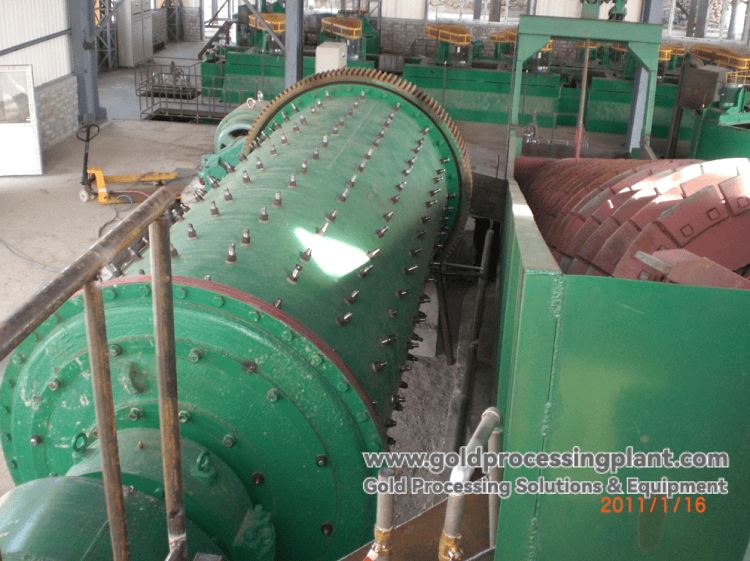
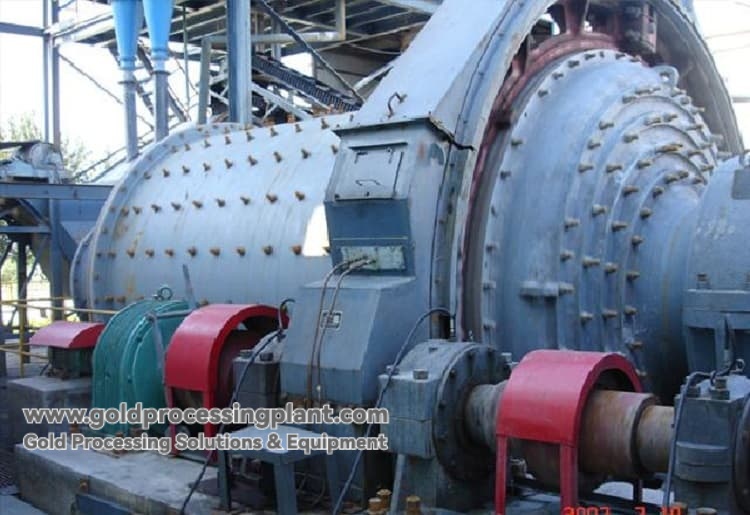
- Ball Mill: Grid-type with forced discharge and high throughput, suitable for coarse grinding or the first grinding stage; overflow-type relies on gravity discharge and achieves finer grinding, suitable for fine grinding or the second grinding stage.Rock gold ore processing commonly employs a two-stage grinding process consisting of a first-stage grid-type mill followed by a second-stage overflow-type mill, with the second stage forming a closed-circuit system with a spiral classifier or hydrocyclone;
- Classification Equipment: Spiral classifiers and hydrocyclones operate in a closed-circuit system with the mill, sending qualified fine powder to the next stage and returning coarse sand for regrinding.
Adhering to the principle of “more crushing, less grinding”: the crushing stage does most of the work, while the grinding stage consumes less electricity.
2. Gravity Separation Section (Early Recovery of Coarse-Grained Gold)
- Centrifugal concentrator: Enhances gravity separation based on centrifugal principles to recover fine-grained gold, silver, platinum group metals, and other precious metals; it is the primary equipment for recovering coarse-grained free gold in the grinding circuit;
- Jig (Sawtooth Wave/Hydraulic): Processes coarse-grain material with high throughput;
- Shaking tables (6-S shaking tables/multi-deck shaking tables): Process fine-grain fractions with high separation accuracy; used for the final concentration of gravity concentrate;
- Spiral Chute: Simple in structure, suitable for roughing and tailings disposal.
Gravity separation typically does not constitute a complete processing flow for gold-bearing rock on its own, but is instead integrated into the grinding circuit or combined with flotation and cyanidation. The degree of liberation is the key indicator of gravity separation recovery; if the grinding fineness is insufficient, gravity separation is ineffective.
3. Flotation Stage (Gold-bearing sulfide ores, fine-grained disseminated ores)
- Floating Machine Series: SF-type self-priming machines, suitable for the front end of roughing and scavenging; XCF/KYF-type aerated machines, the preferred choice for large-scale direct-flow cell configurations; BF-type and JJF-type machines are selected based on throughput and aeration requirements.These can be combined into roughing, scavenging, and cleaning units (ranging from one roughing stage, two cleaning stages, and two scavenging stages to one roughing stage, three cleaning stages, and three scavenging stages);
- Supporting agitation tanks are used for reagent mixing prior to flotation, while thickeners and filter presses are used for concentrate dewatering.
The flotation method can process low-grade, fine-grained disseminated gold ores and is highly adaptable; it is one of the most widely used technologies for rock gold ore processing in China.
4. Leaching and Adsorption Section (CIL/CIP Specific)
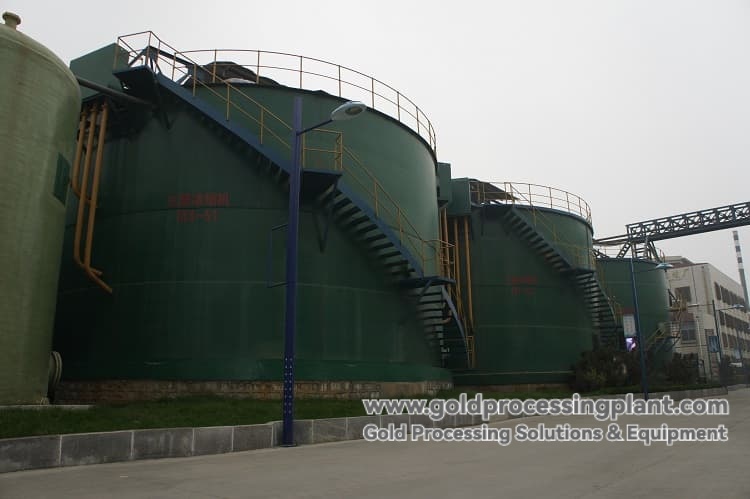
- Leaching tank (with agitation and aeration): Sodium cyanide and lime are added to adjust the pH (10–11) and dissolve the gold;
- High-efficiency dual-impeller carbon-in-leach tank: The CIL process combines leaching and adsorption; activated carbon is added in the final tank and moves forward in a countercurrent flow;
- Activated Carbon Separator: Prevents activated carbon from being carried away with the slurry; Carbon Recoverer: Lifts and extracts gold-loaded activated carbon;
- Desorption and Electrolysis Equipment: Suitable for conventional processing at ambient temperature and pressure; high-temperature, high-pressure desorption ensures more thorough separation and is suitable for large-scale or hard-to-desorb ores;
- Gold smelting furnace: Smelts gold slurry into gold ingots;
- Zinc Powder Displacement Unit (heap leach concentrate, CCD countercurrent wash concentrate): Clarification and filtration → vacuum deoxygenation → addition of zinc powder for displacement → filtration of gold slurry → smelting.The precious metal solution must be clarified to a suspended solids level of <10 ppm and dissolved oxygen of <1 mg/L; the displacement rate is typically >99%.
5. Concentration and Dewatering Section
Thickening machines (center-driven/high-efficiency thickeners) are used for preliminary sedimentation and dewatering of concentrate and tailings; plate-and-frame filter presses compress the slurry into filter cakes and are key equipment for dry tailings disposal; dewatering screens are used for final dewatering.
6. Auxiliary Equipment
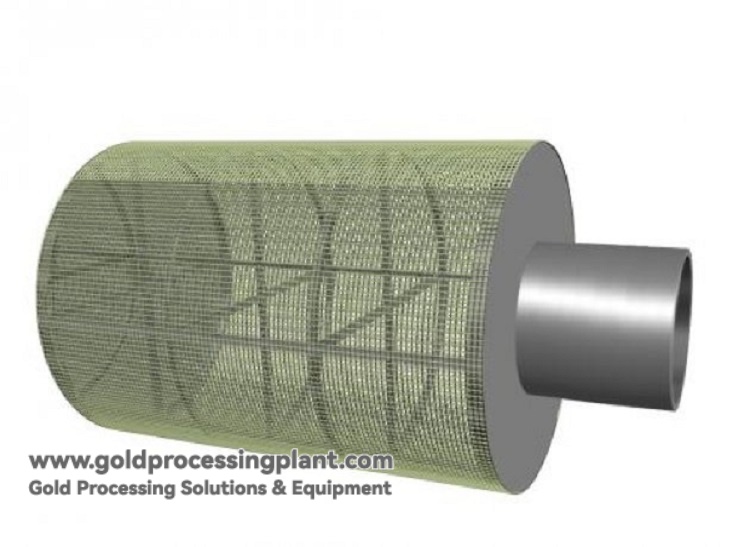
Vibrating feeders, belt conveyors, slurry pumps/carbon-lifting pumps, cylindrical ore washers/screw ore washers (for pre-treatment of ore with high clay content), and trommel screens (for gold-bearing sand processing).
IV. Four Key Considerations for Selecting a Complete Equipment Set
First, determine the process before selecting the equipment.
Equipment should not be haphazardly pieced together from the market; selection must be based on ore characteristics and the process flow. Even with the same flotation cell, recovery rates can differ by as much as 20 percentage points when used on quartz vein-type versus Carlin-type ores; even with the same centrifuge, if the grinding fineness is incorrect, coarse-grained gold will still end up in the tailings.
Second, the process and equipment must be “interlocked.”
If crushers, ball mills, centrifuges, flotation cells, and CIL leaching systems come from different manufacturers, interfaces, production capacity, and energy consumption are prone to mismatches, leading to mutual blame when the system fails to meet standards. Only when process design and equipment manufacturing are managed by the same team can the disconnect caused by “design drawings not matching equipment dimensions” be avoided.
Third, equipment must be customized for the specific ore, not selected from stock.
For high-silica, abrasive ores, flow-path components must be replaced with high-chromium alloy or wear-resistant rubber; in acidic leaching environments, equipment can be upgraded with corrosion-resistant stainless steel or lined with anti-corrosion coatings;special operating conditions—such as extreme cold, high altitudes, or unstable power grids in Africa—require non-standard customization of materials, motor power, and structure (e.g., standard-equipped diesel generator sets and soft-start configurations to reduce inrush current).
Fourth, calculate the total cost rather than competing solely on the lowest bid.
Precise equipment selection eliminates performance overcapacity; integrated design eliminates hidden costs arising from coordination disputes among multiple parties; and energy-efficient design reduces long-term operational consumption. Piecing together a system on your own entails management costs for coordinating multiple parties, rework costs due to incorrect equipment selection, losses from project delays, as well as high energy consumption and maintenance costs in the long run.
V. Investment Estimate Reference: Price Range for CIP/CIL Complete Main Equipment Sets
Taking a complete set of main equipment for a gold mine\'s CIP/CIL/whole-ore cyanidation/leaching process as an example (prices in US$10,000, excluding civil engineering, installation, logistics, and auxiliary materials):
| Daily Processing Capacity (metric tons/day) | Price Range for Complete Set of Main Equipment (US$10,000) |
|---|---|
| 30 | 20–35 |
| 50 | 25–40 |
| 100 | 35–50 |
| 200 | 45–75 |
| 300 | 60–90 |
| 500 | 90–135 |
| 800 | 125–170 |
| 1,000 | 150–190 |
| 1,500 | 205–270 |
| 2,000 | 265–335 |
| 2,500 | 300–380 |
The lower limit of the range corresponds to standard configurations, conventional oxidized gold ores or simple sulfide ores, and standard operating conditions; the upper limit corresponds to non-standard custom configurations, complex ores, special operating conditions, or more comprehensive solutions.These are only reference prices for the complete set of main equipment and do not include civil engineering, installation, or logistics. Specific quotations must be determined based on ore type, process flow, and on-site conditions.
VI. Project Timeline and Scope of Delivery: Don\'t Let “Waiting” Derail Your Investment
For a typical gold mining project, the overall timeline from the start of process design to final commissioning is usually 8–15 months:Process Design and Technical Proposal: 7–15 days → Engineering Design: 20–30 days → Equipment Manufacturing: 60–120 days → Logistics: 30–60 days → Installation and Commissioning: 60–150 days. For overseas projects, an additional buffer of approximately 30 days should be allocated for customs clearance.Reasonably interweaving these phases can shorten the total project duration; providing representative ore samples as early as possible to initiate process design is the first step in reducing the overall timeline.
Regarding the scope of delivery, the standard model is as follows: the supplier is responsible for process design, engineering drawings, manufacturing of core equipment, on-site installation technical guidance, integrated commissioning, and training;while the client organizes civil construction and general installation labor locally. This approach ensures technical quality is guaranteed while helping the client save significantly on costs associated with dispatching domestic workers overseas—including airfare, visas, lodging, and high daily wages. If local construction resources are truly unavailable, a turnkey solution can be negotiated.
VII. Conclusion: For Colloidal Gold Ore Beneficiation, Understand the Ore First, Then Select the Equipment
The challenge with colloidal gold ores has never lain in any single piece of equipment, but rather in whether the “ore—process—equipment” trio is properly aligned. When gold exists in a colloidal state, as fine particles, or in an encapsulated form, every parameter—including grinding fineness, reagent regimens, gravity separation placement, and leaching conditions—must be based on the specific characteristics of the ore.