


Complete Sets of Gold Ore Processing Equipment: Mineral Processing Techniques and Production Line Solutions
Complete Sets of Gold Ore Processing Equipment: Mineral Processing Techniques and Production Line Solutions
When building a gold ore processing plant, many investors\' first instinct is to “buy the equipment first.” However, what truly determines whether a processing plant will be profitable is never the spec sheet of a single piece of equipment, but rather whether the “ore—process—equipment” trio is properly aligned. The same flotation machine can yield a recovery rate difference of twenty percentage points when used on quartz vein-type versus Carlin-type ores;with the same centrifugal concentrator, if the grinding fineness is incorrect, coarse-grained gold will still end up in the tailings. The value of a complete set of gold processing equipment lies not in the length of the equipment list, but in whether each piece of equipment is configured according to the specific characteristics of your ore and the process route.
This article systematically outlines the mineral processing techniques and production line solutions for complete gold processing equipment sets, covering everything from ore classification and process routes to full-process equipment configuration, scope of delivery, and project timelines, providing gold mine investors with a practical configuration guide.
I. Determine the Process First, Then Configure the Equipment: Production Line Logic for Three Types of Gold Mines
The production line design for gold ore beneficiation depends first and foremost on the type of ore. Different ore types have distinct occurrence patterns and entirely different process logics; therefore, equipment configurations cannot be interchanged.
1. Alluvial Gold Deposits: A complete process involving ore washing and gravity separation, with no need for grinding.
In placer gold deposits, gold occurs in free, individual particles within loose sediments such as sand, gravel, and clay, eliminating the need for crushing or grinding. The process logic is as follows: screening and grading via a trommel screen or ore washer → rough selection via chutes → enrichment via a centrifugal concentrator → fine selection via a shaking table → smelting of the concentrated gold.Over-size waste rock is discharged, while the under-size slurry enters the gravity separation system; the recirculating water system recovers most of the process water. Mobile solutions are suitable for dispersed ore sites and short-term mining, while stationary solutions are suitable for concentrated ore sources and large-scale operations.
2. Rock-type gold deposits: Crushing and grinding are prerequisites, and gravity separation, flotation, and cyanidation are combined based on the characteristics of the ore.
In rock-type gold deposits, gold is embedded in rock or sulfides; therefore, crushing and grinding are required to liberate the gold as individual particles before proceeding to the beneficiation process.In quartz vein-type gold deposits, coarse and fine-grained gold coexist; a combined gravity separation and flotation process is recommended: a centrifugal separator is incorporated into the grinding circuit to recover coarse-grained gold early on, while flotation recovers gold-bearing sulfides, and the concentrate is sent for smelting or cyanidation.In skarn-type gold deposits, which consist primarily of fine and ultrafine grains with a high content of clay minerals, flotation is the primary method, supplemented by gravity separation to recover coarse-grained gold; the grinding fineness and desliming stages must be specifically optimized. For gold-bearing sulfide ores, flotation is the primary process.
3. Difficult-to-process gold ores: Pretreatment is key, and combined processes are the main approach.
For difficult-to-process gold ores containing arsenic, carbon, or fine-grained disseminated gold, conventional cyanide leaching recovery rates are typically only 20–50%. Arsenic-bearing ores require flotation to produce an arsenic-gold concentrate, followed by pretreatment before cyanidation;carbon-bearing ores require suppression of carbonaceous material or pretreatment to eliminate gold entrapment; for fine-grained, Karlin-type encapsulated gold, the process involves fine grinding—flotation to concentrate sulfides → pretreatment to release the encapsulated gold → cyanide recovery. In production line designs for these ores, the equipment configuration and reagent regimens in the pretreatment section are often more critical than those in the separation section.
In a nutshell: placer gold deposits rely on washing and gravity separation; bedrock gold deposits rely on crushing, grinding, and combined beneficiation; and difficult-to-process ores rely on pretreatment combined with integrated processes. Without a defined process flow, an equipment list is nothing more than a castle in the air.
II. Full-Process Equipment Configuration: From Primary Crushing to Dry Tailings Discharge
A complete gold ore beneficiation production line typically includes the following equipment sections. Specific configurations may vary depending on the ore type and process route.
Crushing and Screening Section:
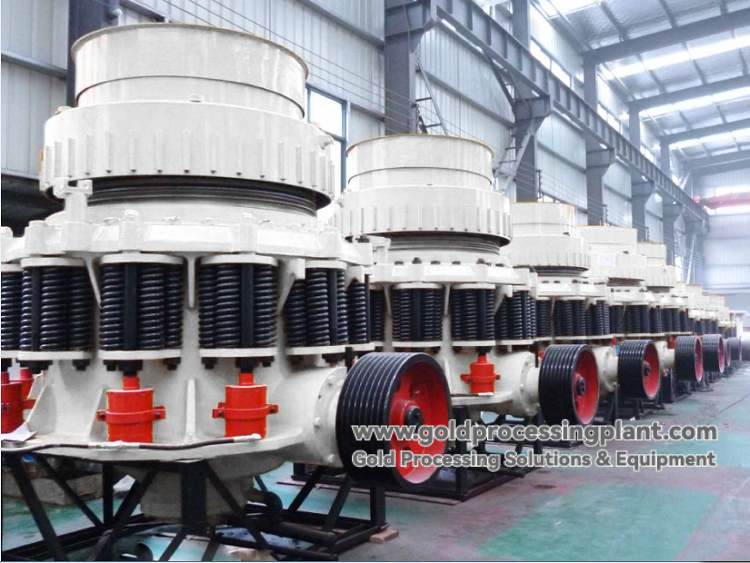
Jaw crushers handle primary crushing, processing large chunks of raw ore; they feature high compressive strength, a simple structure, and durability. Cone crushers handle secondary and tertiary crushing, efficiently processing hard rock with uniform product particle size. Circular vibrating screens and linear vibrating screens are used for material classification.The crushing section follows the principle of “crush more, grind less”—doing more work during the crushing stage to reduce power consumption during the grinding stage. This is the first line of defense in controlling energy consumption at the processing plant.
Grinding and Classification Section:
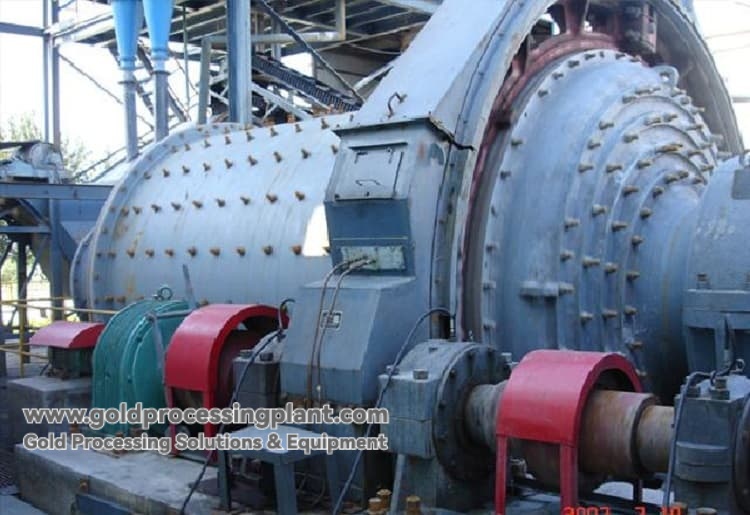
The ball mill is the core equipment in the grinding process.For rock gold ores, a two-stage grinding process is typically employed, consisting of a first-stage grid-type ball mill followed by an overflow-type ball mill: the grid-type mill features forced discharge, high throughput, and resistance to over-grinding, making it suitable for coarse grinding or the first stage; the overflow-type mill relies on gravity overflow, achieves a finer grind, and is suitable for fine grinding or the second stage.The second stage forms a closed-circuit with a spiral classifier or hydrocyclone; qualified fine powder is discharged, while coarse sand is returned for regrinding. Rod mills are suitable for preventing over-grinding of brittle minerals, while gold crushers are well-suited for small-scale mining sites and manual or semi-mechanized gold extraction operations.
Gravity Separation Stage:
Centrifugal separators (such as the Nelson centrifuge) enhance gravity separation based on the principle of centrifugation. Used in the grinding circuit to recover coarse-grained free gold, they are key equipment for “early and high recovery”;Shaking tables (6-S shaking tables/multi-deck suspended shaking tables) are used for fine-grain gravity separation and concentration; chutes (spiral chutes, agitated/gold-adhesive chutes) are used for roughing and enrichment; and jigs are used for the separation of coarse-grained ore.Gravity separation typically does not constitute a complete process for lode gold deposits on its own, but is instead integrated into the grinding circuit or combined with flotation and cyanidation.
Flotation Section:
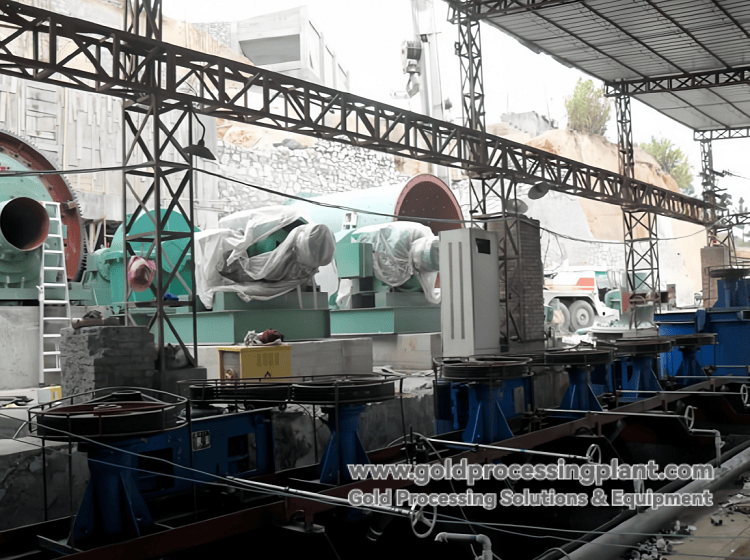
We offer a full range of models, including the SF type (self-priming slurry, suitable for the front end of roughing and scavenging), XCF/KYF types (air-agitated, the preferred choice for large-scale direct-flow cell configurations), BF type, and JJF type, which can be combined into roughing, scavenging, and concentrating units.The flotation method can process low-grade, fine-grained gold-bearing ores and is highly adaptable, making it one of the most widely used technologies for rock gold deposits in China. The fineness of grinding determines the degree of liberation, while the reagent regime determines selectivity.
Leaching and Adsorption Section (CIL/CIP):
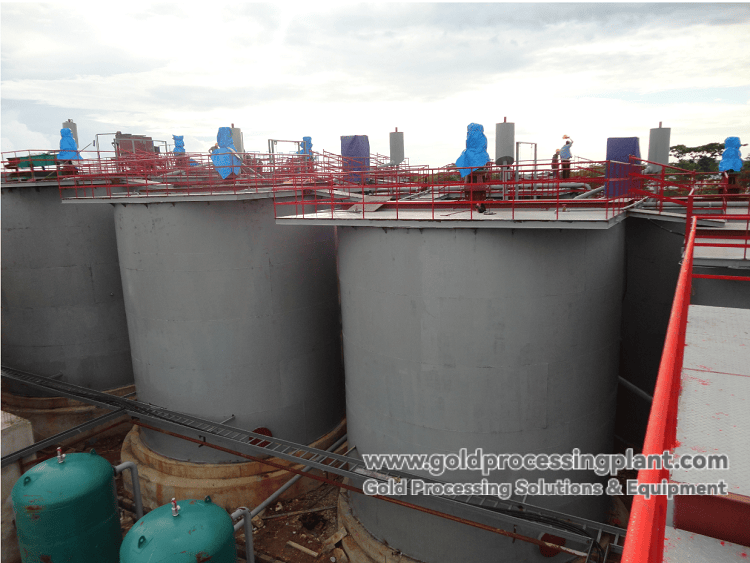
Leaching tanks (with agitation and aeration), activated carbon adsorption systems, gold-bearing carbon separation screens (carbon separator screens/air lifters), carbon lifters, desorption electrolysis equipment (room temperature and atmospheric pressure are suitable for conventional processing; high temperature and high pressure are suitable for large-scale mines or ores that are difficult to desorb), and gold smelting furnaces.CIL involves simultaneous leaching and adsorption and features a compact process flow; CIP involves leaching followed by adsorption and allows for more precise control. The choice between the two depends on the ore\'s leaching rate and the scale of processing.
Zinc Powder Stripping Section (if applicable):
Clarification and filtration equipment, vacuum deoxygenation tower, zinc powder feeding system, displacement column/displacement tank, and gold slurry filter press—suitable for gold recovery from heap leach concentrate and CCD counter-current wash concentrate.The leachate must be clarified to a suspended solids level of <10 ppm and, after deoxygenation, have a dissolved oxygen level of <1 mg/L; the replacement rate is typically >99%.
Concentration and Dewatering Section:
Thickening tanks are used for preliminary sedimentation and dewatering of concentrate and tailings; filter presses compress the concentrated slurry into filter cakes with low moisture content, serving as key equipment for dry tailings disposal; dewatering screens are used for final dewatering.
Feed Conveyance and Auxiliary Equipment:
Vibrating feeders, trough/oscillating feeders, belt conveyors, mixing tanks, slurry pumps, carbon-lifting pumps, and clean water pumps.
Ore Washing and Screening Equipment (Essential for placer gold deposits and high-silt-content ores):
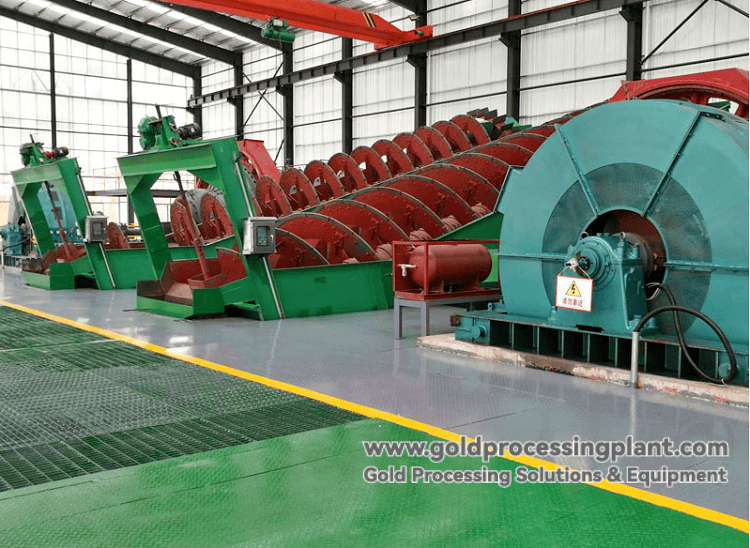
Cylindrical ore washers, spiral ore washers, and trommel screens (including mobile models) are used to wash away mud and prevent clogging of downstream equipment.
III. Core Principles of Equipment Configuration: Configure Based on the Ore, Not on Inventory
The most common pitfall in supplying complete equipment packages is “piecing together a production line”—buying a crusher from Manufacturer A, a flotation machine from Manufacturer B, and a leaching tank from Manufacturer C, then forcing them into a single line.Equipment from different manufacturers often fails to match in terms of interfaces, production capacity, and energy consumption. When the system fails to meet performance standards, equipment manufacturers and contractors tend to pass the blame onto each other, leaving the investor to act as the “referee.”
GoldProcessingPlant\'s approach is to “configure equipment based on the ore”: whether the ore is vein-type or Carlin-type quartz, whether it contains fissure gold or inclusional gold, what the grinding fineness should be, how to formulate flotation reagents, and where to place gravity separation in the grinding circuit—every equipment selection decision is based on the characteristics of the ore.Crushers, ball mills, centrifugal separators, flotation cells, and CIL leaching tanks are all manufactured in-house. Mechanical engineers have a clear understanding of both upstream slurry flow rates and downstream separation requirements, ensuring that interfaces are compatible and production capacity does not mismatch.
When it comes to the specifics of equipment selection, two frequently asked questions are worth exploring:
Should a ball mill be of the grid type or the overflow type?
It depends on the process requirements. Grid-type mills feature forced discharge, high throughput, and are suitable for coarse grinding or the first grinding stage, with a low risk of over-grinding; overflow-type mills rely on gravity overflow, achieve finer grinding fineness, and are suitable for fine grinding or the second grinding stage. The choice must be based on the degree of liberation of the gold ore.
How should the type of flotation cell be selected?
If the process requires self-priming of slurry (such as at the front end of roughing or scavenging), SF or BF types are commonly used; for large-scale direct-flow cell configurations, XCF/KYF or JJF types are more suitable. The selection must be matched to the processing capacity and aeration requirements.
Additionally, special operating conditions may require customized material upgrades: for highly siliceous, abrasive ores, replace flow-through components with high-chromium alloy or wear-resistant rubber; for acidic leaching environments, upgrade to corrosion-resistant stainless steel or apply a corrosion-resistant lining;for conditions such as extreme cold, high altitudes, or unstable power supplies in Africa, non-standard customization of equipment materials, motor power, and structure is required, and power supply solutions are considered during the selection phase.
IV. Scope of Delivery: What Exactly Is Included in an EPC Turnkey Project?
Many investors assume that hiring an EPC general contractor means “I provide the funds, and you handle everything.” In reality, mineral processing projects involve multiple phases—including civil engineering, equipment, installation, and commissioning—and the scope of work is often ambiguous, making it highly prone to disputes such as “work stoppages while waiting for workers” or “mutual buck-passing leading to cost increases.”
GoldProcessingPlant\'s core principle for EPC services is: We take full responsibility for what falls under our purview and ensure it is handled from start to finish; for matters requiring client cooperation, we provide advance briefings.
GoldProcessingPlant is responsible for:
Process design and technical solutions (ore property analysis, process flow determination, reagent regimens, and proposal documents including equipment selection and preliminary quotations);Engineering design and drawings (site layout plans, equipment layout diagrams, civil engineering requirement drawings, and technical briefings); Manufacturing of core equipment and supply of supporting components (manufacturing core equipment according to drawings and coordinating the supply of auxiliary materials such as pumps, piping, and electrical controls);On-site installation technical guidance (dispatching engineers to supervise equipment positioning, pipeline connections, and electrical and instrumentation installation); Integrated commissioning and personnel training (leading individual equipment commissioning and integrated trial runs with water and feed material, optimizing parameters until standards are met and full production capacity is achieved); After-sales service and spare parts supply.
Client Responsibilities:
Civil construction (to be organized independently based on the civil engineering conditions drawings provided by us; complete architectural and structural construction drawings must be issued by a qualified local design institute);Organization of local installation workers (our engineers will provide on-site installation guidance, while the client is responsible for organizing the workforce); On-site “three utilities and one leveling” (water, electricity, and access roads), as well as water, electricity, and materials required for hoisting and commissioning; Local compliance procedures (approvals for environmental protection, safety, construction permits, etc.).
The rationale behind this division of labor is practical: if we were to dispatch a large number of Chinese workers to work overseas or in remote locations, the costs of airfare, visas, lodging, and meals—combined with high daily wages—would drive up project costs;By having the client recruit local general installation workers and having our technical engineers provide on-site guidance, labor costs can be reduced by at least half, and local workers can adapt more flexibly to the progress of on-site civil engineering work.We still assume full responsibility for technical risks—while the client sources the workers, our engineers make the final on-site decisions regarding installation methods and standards, and GoldProcessingPlant is responsible for the final outcome of the equipment and processes. If the client is truly unable to find a local construction team, a turnkey solution can be negotiated and specified separately in the contract.
V. Project Duration: 8 to 15 months, starting as early as the preliminary phase
From the start of process design to final commissioning, the overall timeline for a typical gold mine project is usually around 8 to 15 months.Key Milestones: Process design and equipment selection quotation (7–15 days) → Engineering drawing design (20–30 days) → Equipment manufacturing (60–120 days) → Logistics (30–60 days) → Installation and commissioning (60–150 days).Reasonably overlapping these phases can shorten the total project duration; for overseas projects, additional buffer time should be allocated for customs clearance (approximately 30 days) and a transition period (approximately 30 days).
Many projects suffer severe delays not because the equipment cannot be manufactured, but due to indecision in the early stages or a failure to properly overlap the various phases. Three scheduling recommendations: Provide representative ore samples as early as possible to initiate process design—start “fast” from the very beginning;Once key parameters in the process design are finalized (grinding fineness, number of flotation stages, leaching time), drawings for non-standard equipment can be sent to the factory for manufacturing immediately, allowing design and manufacturing to overlap; During equipment manufacturing and shipment, the client can simultaneously proceed with “three utilities and one leveling” and plant foundation construction based on civil engineering condition drawings, with civil engineering work proceeding first.For overseas projects, be sure to allow sufficient logistics buffer time; never set the production start-up schedule to be “seamless.”
VI. Flexible Phased Services: No Mandatory Bundling
Supplying a complete set of equipment does not equate to mandatory bundling.GoldProcessingPlant supports flexible phased services: clients may opt for mineral processing tests and process validation only; purchase process design and equipment selection quotes only; acquire engineering drawings only; procure individual units or complete sets of equipment; or engage engineers for on-site commissioning only. Clients may also combine services such as “testing + design,” “equipment + installation guidance,” or “design + equipment + commissioning.”Initial payments for mineral processing tests and design fees can be fully offset against the equipment cost when subsequently signing an equipment or EPC contract. Individual pieces of equipment (such as flotation machines, centrifugal mineral separators, crushers, ball mills, and CIL leaching tanks) are also available for purchase without any bundling requirements.
Behind every equipment list lies a process logic. The mineral processing technology and production line solutions for complete gold ore processing equipment are, at their core, a process of translating ore characteristics into process flows and then translating those process flows into equipment configurations.Whether it\'s the washing and beneficiation of placer gold, the crushing, grinding, and combined beneficiation of lode gold, or the pre-treatment and cyanidation of hard-to-process ores—behind the equipment list for every production line lies a set of process logic tailored to that specific ore. First, understand the ore; then, configure the equipment; and finally, work with you to fine-tune the process until gold is recovered—this is the value that a complete equipment supplier should deliver.